
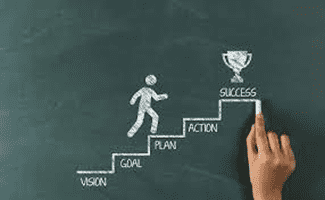
Staying the course and having a built to last retirement plan while not getting distracted by short-term market events, is just as important in retirement as it is at any other time in your life.
Life expectancy
According to the latest ABS statistics, the average male life expectancy is currently 81 years and the average female life expectancy has also increased to 85 years. From a financial perspective, a key question for most of us is whether we’ll have money left over at the end of our life or whether we will have more life at the end of our money.
We want to make sure that we have plenty to last all the way through our retirement years and beyond. In fact, it’s now becoming such a common question that it is officially known as “longevity risk” in financial circles.
The prospect of running out of retirement money before death is very real and reducing financial longevity risk can be a challenge if not well planned for. Building wealth early, along with continuous ‘interest‘ is important to ensuring your retirement goals.
Growing a built to last retirement plan
For many retirees, low-risk assets such as cash and government-backed bonds are often seen as the safest ways of protecting capital over the long term. Yet, putting all your eggs into low-risk asset classes may expose you to investment hazards over the longer term.
Depending on your broad retirement goals and tolerance for risk, what you may see as a safe investment strategy today may not be that, and could easily become the very opposite over time. And retiring from work shouldn’t necessarily equate to retiring from managing your investment portfolio.

In fact, we encourage retirees to remain active in growing a built to last retirement plan alongside their financial advisor during retirement, as it will ensure you have the best chance of protecting and growing your investment capital over time.

Avoid knee-jerk decisions
As global markets fell sharply during the early part of 2020, some retirees hastily chose to divest their equity positions in favour of the relative safety of cash. We get short-term periods of market volatility can be unsettling. But in doing so, they in fact may have totally missed the strong rebound in global equity markets that quickly followed and effectively crystalised their equity losses.
This is a powerful example when it comes to achieving investment success and growing a built to last retirement plan, why time in the market will invariably win over trying to time the market. So, staying the course, and not getting distracted by short-term market events, is just as important in retirement as it is at any other time.
Focus on the things you can control.
Instead of handing over your power, take control of your finances and this includes reviewing your spending regularly and making sure you’re invested in products that have low management costs. Growing a built to last retirement plan with an annual review is always a great undertaking for staying on course. And it’s also important to lower your investment costs where you can, which means the more money you have to enjoy in your retirement.
The best approach to building an investment portfolio that will help protect your retirement capital is to apportion funds across different asset types, such as shares, bonds, property, and cash.
Staying on course and having a well-diversified portfolio will offset the risks of being too exposed to one asset class.
Diversification pays off
The chart below shows the Australian share market has produced an average annual return of 9.0 per cent since 1992. To help preserve capital and generate longer term capital growth along with income, the latest Vanguard chart underscores the importance of growing a built to last retirement plan and having good asset diversification, even in retirement.
The dollar figures in the index chart are calculated over the 30 years, on the basis that all of the distributions are including interest and dividends, had been reinvested back into the same assets to maximise the returns including the compounding effect of those returns.
From the index chart below it shows $10,000 invested into different assets in 1992, you can see that it would have produced very different cumulative returns, ranging from $182,376 (U.S. shares) through to $35,758 (cash).
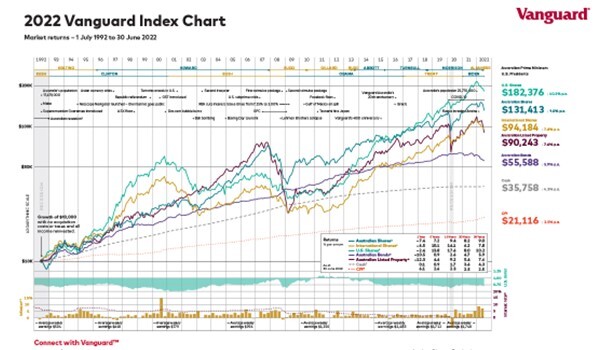
The historical data going back for decades shows that despite inevitable short-term price dips, asset classes perform differently from year to year, but, over the long term you can expect each asset class will deliver growth.
HINT: It never makes sense to chase after last year’s returns as it shows that since 1992 there have only been a handful of occasions when the same asset class has been best performing in consecutive years. For example, in 2018-19 Australian listed property was the best-performing asset class, returning 19.3 per cent.
Just a year later the same segment showed a negative return of 21.3 per cent (primarily due to the impact of COVID-19) – a reversal of 40.6 per cent.
The value of creating a built to last retirement plan
That’s where creating a built to last retirement plan to future proof your finances and investing across a range of asset classes , including during your pension drawdown phase, will help smooth out poorer returns from other asset classes from year to year.
If having more money to have and enjoy your retirement is important to you, the best approach is to build an investment portfolio that will help protect your retirement capital. If you need help to build a well-diversified portfolio that can offset the risks of being too exposed to and to live well in retirement, contact us here.
REMEMBER, action is power!
Until next time,
Make the rest of your life the best of your life.

Arthur Panagis
Author, Founder, Wealth Coach and Financial Strategist
B.Bus (Accountant)
Grad Dip (Financial Planning)
Professional Certificate in Self Managed Super Funds
ASX Listed Equities Accreditation
Tax (financial) Advisor
<= SHARE THIS STORY
Disclaimer: This article is factual information only. It is not intended to imply any recommendation about any financial product(s) or to constitute tax advice. The information in the article is reliable at the time of distribution, but may not be complete or accurate in the future.