
Knowing and applying this information gives you the emotional discipline and power of rational decision-making when you are in stress and the world and our finances are under pressure.
We will show you how and why the cycle of emotions causes these fluctuations during times of financial uncertainty, what you can do about it and how this theory relates to your every day life.
The Cycle of Emotions during times of financial uncertainty
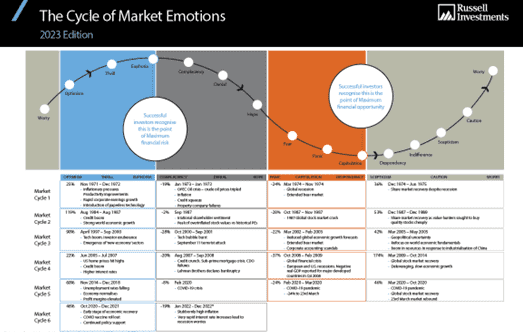
The chart below is a good reminder and a powerful visual representation of how investor emotions tend to fluctuate over the course of a market cycle.
This chart from Russell Investments, titled The Cycle of Emotions is depicted as a roller coaster as it captures the psychological and emotional journey investors experience as financial markets move through various phases. Understanding this cycle is extremely valuable for investors, but as you will see, the cycles of emotion are also present in our daily life. The same theory applies.
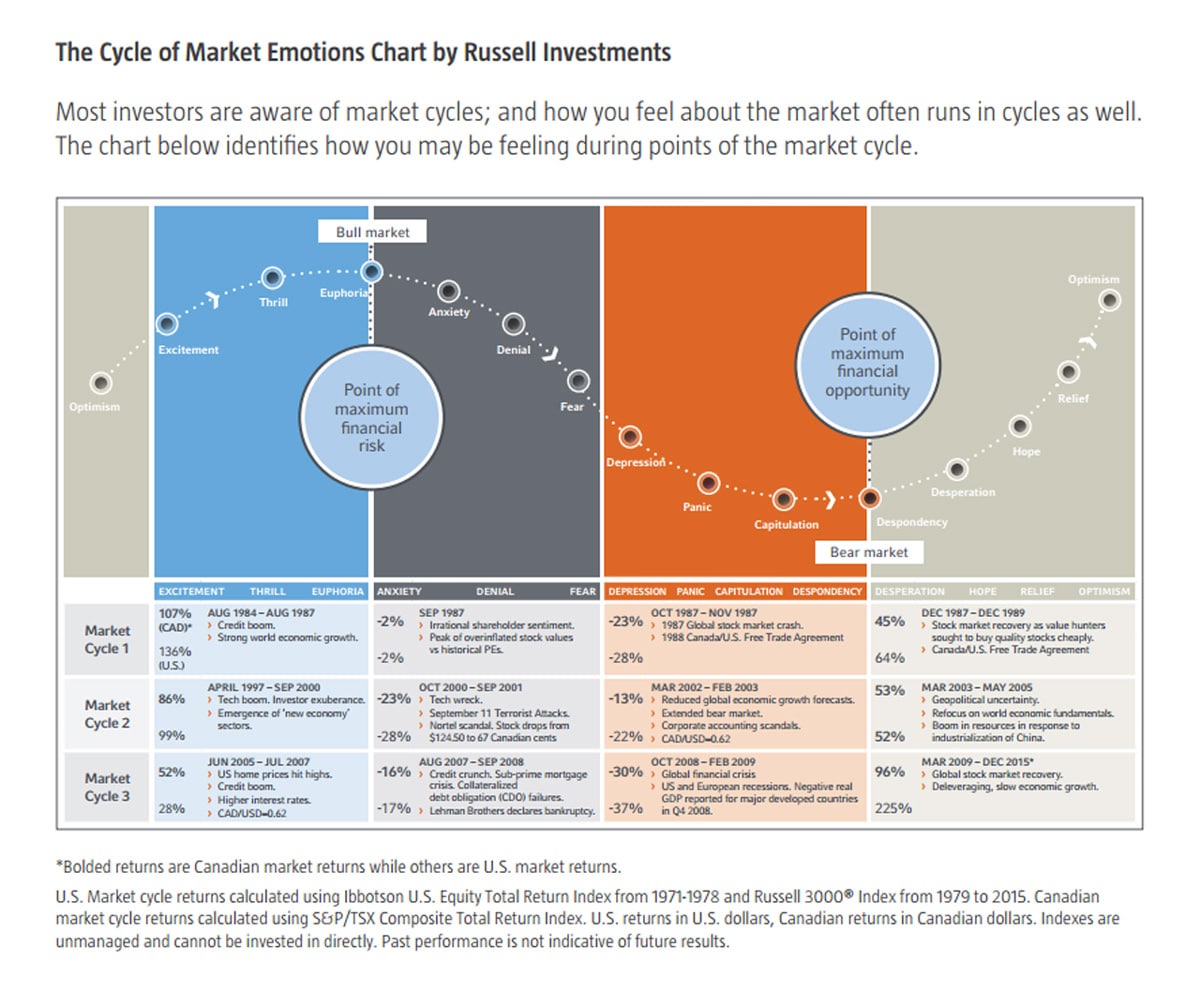
The 4 Cycle Phases:
.
💡 The Roller Coaster Analogy – PLUS 4 Behavioral Insights
. The roller coaster analogy represents the perfect visual and is a poignant reminder of the emotional ups and downs that we all experience through out life, and reflects the same experiences as an investor. This ideal analogy underscores the importance of emotional discipline throughout any cycle; this is a typical market cycle.
1). Behavioral Finance Insights: The Cycle of Emotions chart demonstrates how human emotions can lead to irrational investment decisions, but for investors who can recognize these emotional swings they are better equipped to strategically plan for more wealth and make rational choices.
2). Contrarian Investing: By further understanding the cycle of emotions, contrarian investors have a valuable tool for buying when others are panicking and selling when others are euphoric (at the top of the cycle) and this can lead to more profitable outcomes.
3). The Value of Long-Term Investing: This chart also emphasizes the need for a long-term investment perspective. As we now know, markets are cyclical and in the most part, tend to recover from downturns. Panic selling during a downturn can result in compounding losses and missed opportunities for long-term growth.
4). Risk Management: The Cycle of Emotions chart also underscores the importance of risk management, through diversification. Diversifying investments, setting clear financial goals and objectives, and having a well-thought-out investment strategy will help investors navigate the emotional roller coaster of market cycles. .
💰 So, we have talked about financial emotions, now let’s take a moment to grasp how is this theory related to your every day life.

The Cycle of Emotions is not just a theory relevant to financial markets;
– it has broader applications to your everyday life.
. Here’s how this concept relates to various aspects of life:
❇️ Emotional Resilience: Understanding the cycle of emotions can help individuals build strong emotional resilience. Just as investors need to remain composed during market fluctuations, people can apply these principles to cope with the ups and downs of life, whether it’s personal challenges, career setbacks, or relationship issues.
❇️ Informed and Unemotional Decision-Making: Emotional discipline and rational decision-making are crucial not only in finance but in daily choices. Recognizing when emotions like euphoria or panic are clouding judgment can prevent impulsive decisions, whether it be a conversation with a spouse, family member or colleague, buying a car, making a career move, or even deciding on a major life change.
❇️ Relationships: The cycle of emotions can be well utilized in interpersonal relationships in business, family and social situations. In the initial stages of a relationship, starting a business, changing a career etc, there’s often euphoria, but this can lead to complacency, skepticism, and even moments of panic as the relationship, business, career etc evolves through stages of natural course. Understanding these emotional cycles and fluctuations can help not only you, but partners and others navigate challenges more effectively.
❇️ Career and Work: In the workplace, employees and managers can experience a similar emotional cycle. During a boom or good financial times, at the start of a new career or business venture there may be euphoria and overconfidence, while during difficult times, anxiety and panic may set in. Recognizing these patterns can lead to better decision-making, communication, job selection to managing teams.
❇️ Health and Wellbeing: People’s emotions can also follow a cycle in terms of health and wellbeing. For example, in a fitness journey, initial progress may lead to euphoria, while plateaus or setbacks can trigger skepticism, panic and even capitulation. Recognizing these emotional states can help individuals maintain a long-term commitment to their health.
❇️ Goal Setting: The cycle of emotions can be applied to setting and achieving personal goals. The initial enthusiasm (euphoria) is often followed by periods of self-doubt (skepticism), indifference and worry. Recognizing these emotional phases can help people persevere when they encounter challenges on the path to their goals.
❇️ Entrepreneurs and Business Owners: Entrepreneurs often ride the emotional roller coaster as they build businesses. The thrill and optimism of starting a venture can give way to uncertainty and even panic during difficult times. Understanding this cycle can help business owners and entrepreneurs make more informed decisions to prepare to ride the next wave.
❇️ Education and Learning: The cycle of emotions also applies to the process of learning and education. Initial enthusiasm for a subject may give way to doubts and frustrations as the material becomes more challenging, so in undersatnding and recognizing this pattern it can help all learners persevere and succeed.

In essence, the Cycle of Emotions chart is a valuable model for understanding how emotions impact decision-making and experiences across various facets of life.
This is also an important concept throughout my book, The Art of Building Wealth – worth a re-read and refresh on the principles of building wealth.
It also emphasizes the importance of emotional self-awareness, discipline, and the ability to make rational choices, even the most streeful times; which can lead to more balanced and successful outcomes in both financial and non-financial contexts.
A final word; let’s take a look at the Vanguard chart below which shows a 30 year period and highlights all sorts of crisis all over the globe and the index whilst volatile continues to rise albeit drops during these crisis events normally no lower than a previous high.
I think this is a good snapshot of taking current events into perspective and whilst we can’t predict the future we do see rhymes and rhythms.

The value of creating a built to last investment plan
If creating a built to last investment plan and having more money to invest to enjoy your retirement with passive income is important to you, the best approach is to manage your emotions while building an investment portfolio that will help increase and protect your retirement capital.
And as always, if you need help to plan and build a well-diversified portfolio that can offset the risks of being too exposed, and to live well in retirement, contact us here.
REMEMBER, action is power!
We want you to make the rest of your life the best of your life.

👉 P.S. Check out my 2 minute video here explaining the cycle, and when to buy, and when not to buy.
** (Please subscribe and leave a 👍 if you like it) **
Arthur Panagis
Author, Founder, Wealth Coach and Financial Strategist
– B.Bus (Accountant)
– Grad Dip (Financial Planning)
– Professional Certificate in Self Managed Super Funds
– ASX Listed Equities Accreditation
– Tax (financial) Advisor
<= SHARE THIS STORY
Disclaimer: This article is factual information only. It is not intended to imply any recommendation about any financial product(s) or to constitute tax advice. The information in the article is reliable at the time of distribution, but may not be complete or accurate in the future.
❇️ See our ‘Guide to Successful Investing’ here