
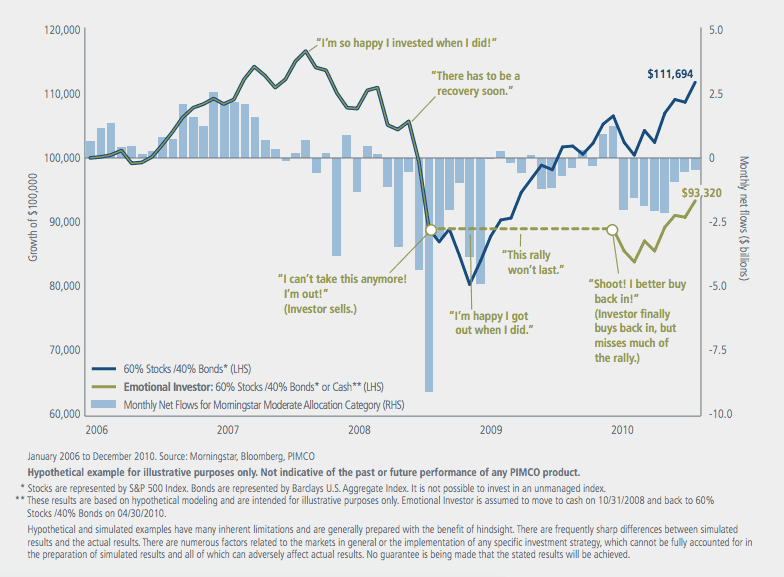
Investors are more likely to reach their long-term goals by avoiding emotionally driven and or fearful short-term decisions. These types of short term decisions may take investors off course thus nullifying the benefits of staying invested.
What this chart shows
Firstly, as this hypothetical example shows, investors may make suboptimal decisions when emotions take over. Emotional investors tend to buy out of excitement when the market is going up and sell out of fear when the market is falling. The benefits of staying invested takes advantage of the markets when they ultimately normalize. And they generally do. Therefore, those who have stayed may benefit more than those who don’t.
What it means for investors
Most importantly, to help reason prevail, first make sure you’re comfortable with your allocation to riskier assets and that it fits into your risk tolerance profile. You also need a logical framework for financial decisions. As well as a plan that anticipates periods of market turbulence. The benefits of staying invested and having systematic approach for reviewing portfolio results, with pre-established guidelines for selling, may also help.
A word about risk:
Investing in the bond market is subject to risks. This includes market, interest rate, issuer, credit, inflation, and liquidity risk. The value of most bonds and bond strategies is impacted by changes in interest rates. Bonds and bond strategies with longer durations tend to be more sensitive and volatile than those with shorter durations. Bond prices generally fall as interest rates rise.
Consequently, the current low interest rate environment increases this risk. Current reductions in bond counter-party capacity may contribute to decreased market liquidity and increased price volatility. Bond investments may be worth more or less than the original cost when redeemed. Equities may decline in value due to both real and perceived general market, economic and industry conditions.
The S&P 500 Index is an unmanaged market index, generally considered representative of the U.S. stock market as a whole. The index focuses on the Large-Cap segment of the U.S. equities market. Barclays U.S. Aggregate Index represents securities that are SEC-registered, taxable and dollar denominated. The index covers the U.S. investment grade fixed rate bond market.
Also, with index components for government and corporate securities, mortgage pass-through securities and asset-backed securities. These major sectors are subdivided into more specific indexes and are calculated and reported on a regular basis. It is not possible to invest directly in an unmanaged index.
It’s important to note that investing in the stock market carries risks, and it’s always recommended tthat you consult with a trusted financial advisor and conduct conduct a risk profile analysis and establish your financial and lifestyle goals before making any investment decisions.
💰 Here are our Top 5 benefits of staying invested
Once you decide this is one of your wealth building strategies, staying invested in the stock market can offer several benefits. Here are five key advantages:
#1.Potential for Long-Term Growth: Historically, the stock market has shown the potential for long-term growth. Despite short-term fluctuations, the benefits of staying invested in the long term, sees that the trajectory of the market trend upward. By staying invested, you have the opportunity to benefit from the growth of the economy and individual companies over time.
#2. Wealth Accumulation: Investing in stocks allows you to accumulate wealth by leveraging the power of compounding. Through reinvesting dividends and capital gains, your investment can grow exponentially over the long run. This wealth accumulation can help you meet your financial goals such as retirement, education expenses, or purchasing assets.
#3. Diversification: The stock market provides access to a wide range of investment options, including stocks of different companies, sectors, and regions. By diversifying your portfolio, you can spread your risk and reduce the impact of any individual investment’s performance. This diversification helps protect your capital and can potentially enhance your overall returns.
#4. Income Generation: Many stocks offer dividends, which are regular cash payments to shareholders. By investing in dividend-paying stocks, you can get the benefits of staying invested and generate a steady income stream. This income can be reinvested or used to supplement your regular cash flow needs. Dividends can be particularly beneficial during periods of low interest rates when other fixed-income investments may offer lower returns.
#5. Hedge Against Inflation: The benefits of staying invested in stocks can serve as a hedge against inflation. Over time, as the general price levels rise, companies tend to increase their prices, revenues, and profits, which can be reflected in their stock prices. By staying invested in the stock market, you have the potential to preserve the purchasing power of your wealth and outpace inflation.
📈 The benefits of staying invested – BONUS TIP
The Law of Compounding.
The Law of Compounding applies to everyone… and is always working. The accumulated compounding effect is profound. We have a link below so that you can see how the compound effect works in our $5 per day example.
💡 If you need more information or help to establish a strategy to build your wealth by taking the advantage of the long term benefits of staying invested, contact us today on 08 7111 0022 or book a chat to see how we can best help you here

Arthur Panagis
Author, Founder, Wealth Coach and Financial Strategist
B.Bus (Accountant)
Grad Dip (Financial Planning)
Professional Certificate in Self Managed Super Funds
ASX Listed Equities Accreditation
Tax (financial) Advisor
REMEMBER, action is power!
💪 We want to make the rest of your life the best of your life.
– Head Office –
Suite 2, Level 1, 148 Greenhill Rd,
PARKSIDE SA 5063
Ph – 08 7111 0022
Email – info@fmgws.com.au
👀 You can read about how the Law of compounding works here
<= SHARE THIS STORY
Disclaimer: This article is factual information only. It is not intended to imply any recommendation about any financial product(s) or to constitute tax advice. The information in the article is reliable at the time of distribution, but may not be complete or accurate in the future.
Past performance is not a reliable indicator of future results.
Disclaimer: This article is factual information only. It is not intended to imply any recommendation about any financial product(s) or to constitute tax advice. The information in the article is reliable at the time of distribution, but may not be complete or accurate in the future. For information about a loan that may be suitable for you, call us on 7111 0022.